
![]() |
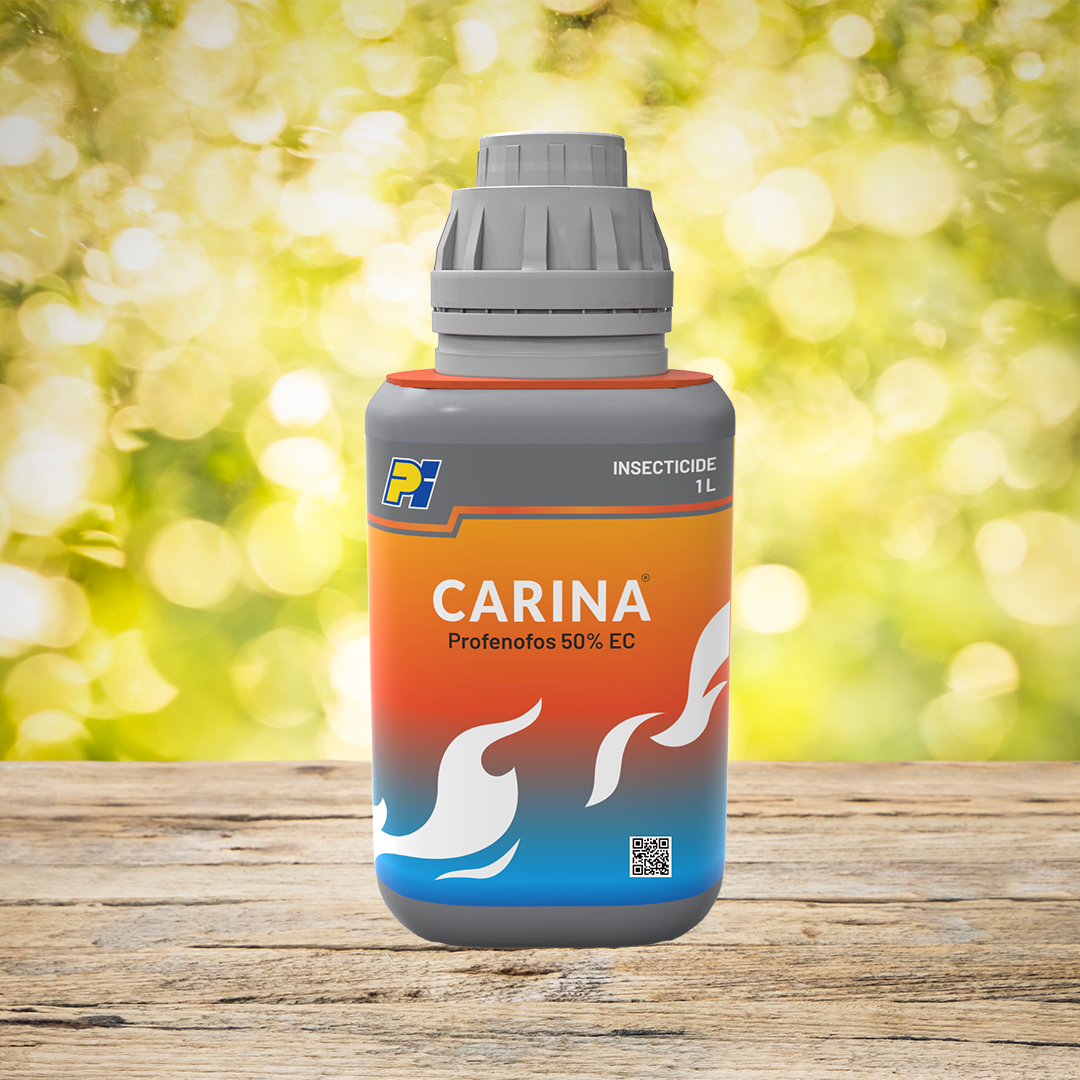
CARINA® is a broad spectrum organophosphate insecticide and acaricide. CARINA® is based on the high quality Profenofos technical manufactured by PI Industries Ltd., PI Industries is the world's second largest producer of Profenofos technical. |
Physical and Chemical Properties
Trade Name: CARINA®
Common Name: Profenofos
Chemical group: Organo-phosphorous
Chemical name: O- (4-bromo-2-chlorpheny) O-ethyl-S-propyl phosphorothioate
Empirical formula: C11H15BrClO3PS
Appearance: Pale yellow liquid
Odor: Garlic like
Molecular Weight: 373.6
Boiling point: 110°C at 0.001 mm Hg
Flash point: 167°C
Vapour Pressure: 1.24 x 10⁻⁴ pa at 25°C 1.3 m pa at 20°C
Refractive Index: 1.5493 - 15495
Density: 1.455 gm/ml at 20°C
Solubility: In water 20 mg/litre at 20°C; 25 mg/litre at 25°C.
Stability: Relatively stable under neutral and slightly acidic condition.
Compatibility: Unstable under alkaline conditions
Reactivity: Stable under normal conditions
Hydrolysis: At 20°C, 50% loss (Calculated) in 93 days at 5 pH; 14.6 days at 7 pH, 5.7 hours at 9 pH
Decomposition: Thermal decomposition observed
Polymerization: Not pertinent
Flammable material: Oxidizer
Features
Mode of Action
CARINA® with unique mode of action has superior advantages over several other products. As a member of the organophosphate family of insecticides, CARINA® works by potent inhibition of the enzyme acetylcholinesterase, which is essential for the transmission of impulses between nerve cells. After feeding on a CARINA® treated plant or crawling over a treated leaf, the pest is first paralyzed and then quickly dies.
Application
It can be applied by both high volume and low volume spray equipment. Water dilution depends on the type of sprayer to be used, crop stage and intensity of pest infestation. It is desirable to calibrate before hand to estimate the quantity of water needed for preparation of solution. Prepare homogeneous solution by agitating with stick. Always spray in the direction of wind and apply uniformly with complete coverage. Interval between two sprays should be 10 to 15 days. No undesirable residues are noticed in different plant parts if used as directed.
Recommendations:
| Crop | Insect |
| Cotton | Spotted bollworm, Pink bollworm, American bollworm, Prodenia, Aphids, Jassids, White Fly, Thrips |
| Rice | Plant and leaf hopper, Leaf roller, Hispa, Army worm, Climbing cutworms |
| Chilies | Fruit borer, Thrips, Mites |
| Vegetable crops | Shoot/fruit borer, Diamond Back Moth, Cabbage looper, Caterpillar, Leaf miner, Thrips, Aphids |
| Beans and pulses | Pod borer, Blue beetle, Girdle beetle, Stem fly, Spodoptera, Hairy caterpillar and Semilooper |
| Peanut | Leaf folder, Hairy caterpillar |
| Tobacco | Prodenia |
| Jute | Semilooper, Hairy caterpillar |
| Cardamom | Thrips |
| Citrus | Leaf miner, Psylla, Citrus butterfly, Mites |
| Tea | Red Spider Mites, Pink Mites, Tea Mosquito Bug, Looper caterpillar, Thrips |
Packaging
Available in 100 ml, 250 ml, 500 ml,1 Liter and 5 Liter.
Antidote
Administer Atropine Sulphate intravenously 2 – 4 mg at 5 – 10 minutes interval until the symptoms of poisoning disappear. 2-PAM can be given in severe cases intravenously very slowly (1 – 2 gm taking 5 – 10 minutes).
Precautions

